
Looking for an AI-Proof Career? The Trades are a Smart Choice.
by TODD OPPENHEIMER

photo by Andrew Sullivan
As a new school year begins—whether you’re in college or still in high school—this is a time when young people often start to think more seriously about their next steps.
Looming over those decisions these days is an entirely new threat: artificial intelligence, and its potential to eliminate any number of white-collar jobs, for which many students have put themselves through years of study, and taken on thousands of dollars of debt in the process.
The professions most vulnerable to AI include everything from accounting, finance, data analysis, and law to fields often considered creative, such as computer coding, journalism, and writing in general. But fret not. There is a plethora of well-paying jobs that, at least for now, are considered safe from AI’s seemingly insatiable appetite.
If you look at this list, for example, from the U.S. Career Institute, you quickly notice a pattern: The most AI-resistant jobs are those that require interpersonal skills, and doing physical work with one’s hands.
That latter category—working with your hands—includes a family of professions that have long been called “the trades”: carpenters and construction workers, plumbers, electricians, pipe-fitters, engineers, and others who can build homes and factories, as well as the energy systems of tomorrow. Yes, government policy may now favor oil and other fossil fuels, but that can only last so long. Given the world’s unavoidable constraints, both in our environment and in fossil fuel supplies, at some point we will be forced to develop solar, wind, and other cleaner, more abundant energy systems. No one expects an AI bot to do that work.
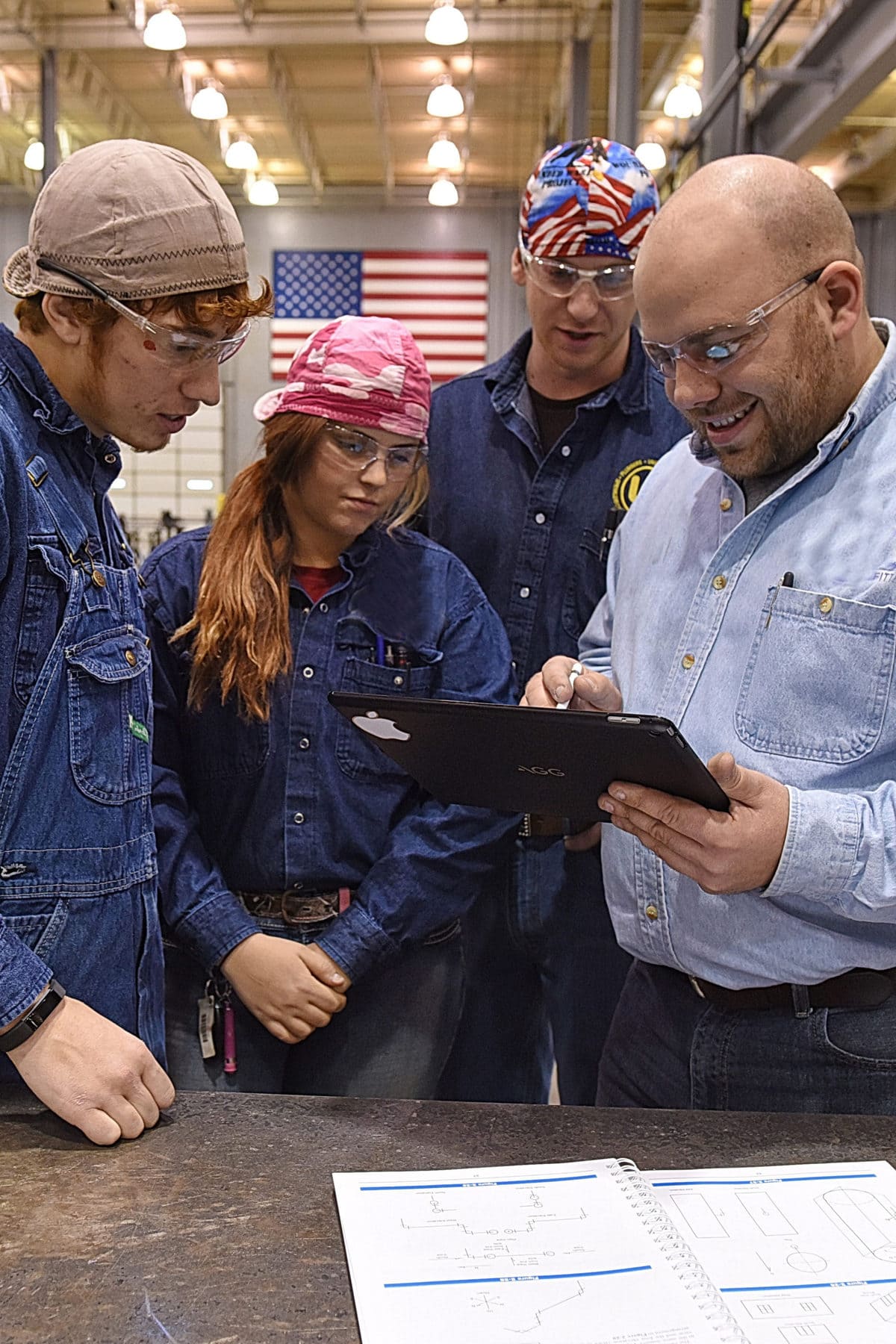
School enrollment already seems to be echoing these trends. According to ADP, a payroll research firm, between 2019 and spring 2024, enrollment of bachelor’s degree students fell by 3.6 percent, and associate’s degree enrollment fell even further, by a whopping 15.9 percent. During the same time period, enrollment in vocational education (a.k.a. trade schools) rose—by 4.6 percent.
A big reason for this shift is simple economics. Those who enroll in trade schools, as we reported a few years ago, generally don’t go into debt to finance their studies. Quite the opposite, in fact: many get paid while they’re in school—for doing apprentice work as part of their studies. (See “The Apprenticeship Ambivalence.”)
Seeing these trends, and how the trades can protect young people from AI’s predations, educators all the way down to the high school level are now turning their attention back to the trades. Just this past March, The Wall Street Journal reported that, across the country, one school after another has started investing again in shop classes—a segment of the curriculum that, beginning in the 1990s, was drastically cut to make room for computer labs. And the shop classes of today offer a lot more than woodworking. Many are outfitted with state-of-the-art metal machining, computerized routers, and other high-tech manufacturing equipment.
In Wisconsin, for example, according to the state data reported in the Journal, 32,000 high-school students took classes in architecture and construction during the 2022-2023 school year, a 10 percent increase over the prior year; another 36,000 enrolled in manufacturing courses—13 percent more than the year before. “There’s a paradigm shift happening,” said Jake Mihm, an education consultant in the Wisconsin Department of Public Instruction. “They’re high-skill, high-wage jobs that are attractive to people because they’re hands-on, and heads-on.”
Tom Moser, who runs a car dealership in Bakersfield, CA, put it this way: “You can pretty much write your own ticket once you’ve acquired the skills.”
Moser practices what he preaches. After trying and failing to attract experienced workers, he started hiring high school graduates—well, those who had taken shop classes. The students start at $19 an hour; if they stick with it, he said, within four years they can be making six-figure salaries.
Not a bad haul for someone without a college degree. Plus, most jobs in the trades keep you physically active, often outdoors in the fresh air. That beats sitting inside on your butt all day in front of a mind-numbing computer screen, often for lower pay.

© 2026 Todd Oppenheimer. All rights reserved. Under exclusive license to Craftsmanship, LLC. Unauthorized copying or republication of any part of this article is prohibited by law.